
A polished dashboard won’t fix unreliable records. Effective sports programme data reporting starts with consistent information, captured in a way your team can trust and use to make decisions.
When participation details are scattered across bookings, registers and staff updates, preparing a report can mean a slow exercise in joining the dots. If programmes also use different definitions of success, comparisons become difficult and managers may struggle to see where attention is needed.
This guide explains how to build a repeatable reporting process, from agreeing data definitions to choosing measures that answer practical questions about participation, attendance and delivery. You’ll learn how to check records and present findings clearly for managers and commissioners. Start with the questions your team needs to answer, then gather the relevant information consistently. That’s how reporting becomes more than a summary of activity: it becomes a sound basis for decisions.
Key Takeaways
- Start with the decision or reporting question, then collect only the information that helps answer it.
- Map records from bookings, registrations, attendance and staff updates, and agree shared definitions so figures are consistent.
- Choose measures that distinguish programme delivery from participant activity, and match each measure to a practical question.
- Make sports programme data reporting repeatable by setting a reporting period, checking records and summarising the findings.
- Separate recorded results from interpretations and proposed actions so managers and commissioners can understand the evidence.
Sports programme data reporting: define the question before collecting data
A report is useful when it helps someone decide what to do next. For a sports programme, data reporting means organising information about delivery and participation into a clear account of what was planned, what took place and who took part. Data collection records activity. Reporting selects, checks and explains that information so it can support planning, oversight and evidence-based conversations.
That distinction matters. A booking record alone won’t show whether a session ran, and an attendance figure needs context before it can inform a decision. Sports programme data reporting isn’t about including every available figure. It’s about making relevant information consistent, useful and easy to understand. The wider field of Sports analytics also explores how data can inform performance and business decisions, but programme reporting should focus on the questions your organisation needs to answer.
What questions should a sports programme report answer?
Begin with a decision, not a spreadsheet. Ask what managers need to decide about delivery, capacity or future sessions, then identify the evidence that would help. To check whether planned sessions ran, for example, compare the delivery plan with records of sessions actually held. If the decision is whether to add capacity, consider bookings and attendance alongside the places available.
Keep operational questions distinct from funder or commissioner requirements. Your team may need a practical view of delivery issues, whilst an external report may call for evidence against agreed programme aims. Both matter, but combining them without a clear purpose can make a report difficult to use. Write down the question, intended decision and reporting period before gathering figures.
Who uses programme reports, and what do they need?
Management teams need a readable view of programme delivery and participation to support day-to-day oversight and forward planning. Funders and commissioners need relevant evidence presented clearly, with enough context to understand what the figures cover. Readers shouldn’t have to guess whether a total refers to bookings, unique participants or attendances.
Agree the audience and purpose before choosing what to show. A short management update and a commissioner report may use the same records but need different emphasis. State the scope plainly, including the programmes and period covered, and label measures in familiar terms. This helps each reader interpret the evidence and discuss it confidently.
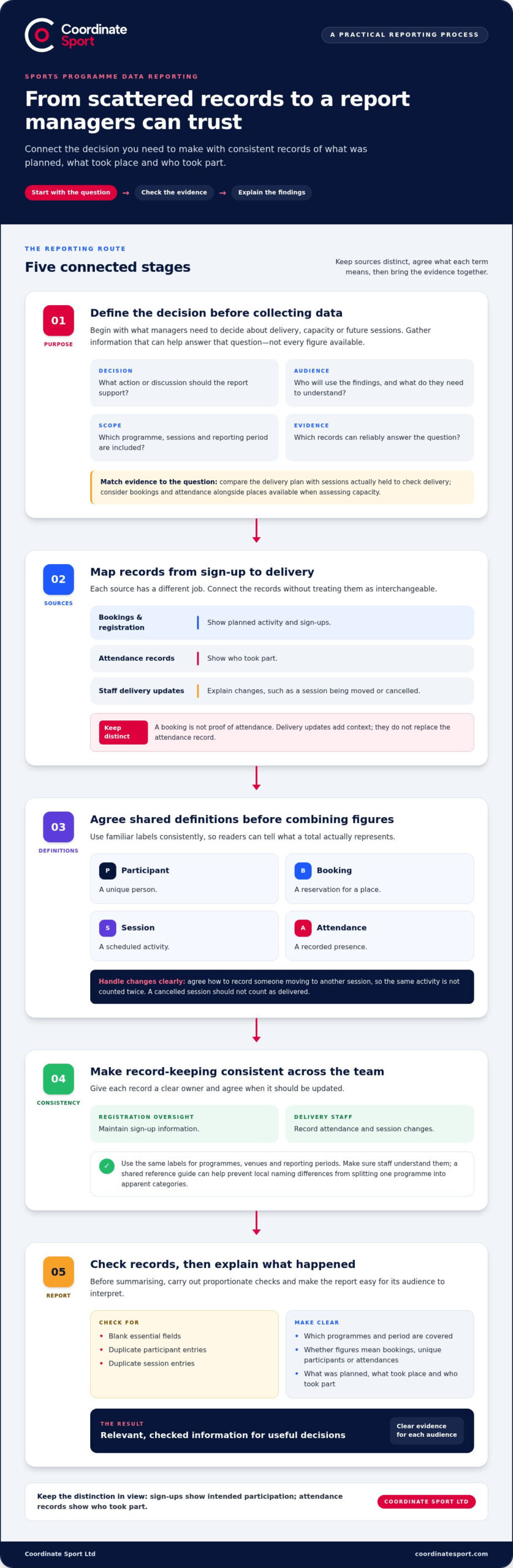
Use these prompts to set a firm reporting brief:
- Decision: What action or discussion should the report support?
- Audience: Who will use the findings, and what do they need to understand?
- Scope: Which programme, sessions and period are included?
- Evidence: Which records can reliably answer the question?
Once those choices are clear, data gathering becomes more focused. Your team can prioritise information that serves a purpose rather than collecting figures simply because they’re available. That’s the starting point for reporting managers can act on and external stakeholders can follow.
Build a reliable sports programme dataset from bookings to attendance
A trustworthy report relies on records that connect planned activity with what happened on the day. For sports programme data reporting, map the journey from booking and registration through to attendance and staff updates about delivery. Each source answers a different question: sign-ups show intended participation, attendance records show who took part, and delivery updates can explain why a planned session changed or did not run.
Keep these sources distinct, even when they relate to the same person or session. A booking is not proof of attendance, and a cancelled session should not count as delivered. Define the terms your team uses before combining figures: a participant might mean a unique person, a booking a reservation for a place, a session a scheduled activity, and attendance a recorded presence. Agree how to handle changes, such as a participant moving to another session, so the same activity isn’t counted twice.
Which source records support programme reporting?
Use booking and registration records to understand planned activity and sign-ups. Compare them with attendance records to distinguish interest from actual participation. Staff delivery updates add context, such as a session being moved or cancelled, but should explain the change rather than replace the attendance record.
Consistent record-keeping matters across different types of programmes. The Datalys Center for Sports Injury Research manages sports injury surveillance programmes, illustrating how structured records can support meaningful analysis. The same principle applies to programme operations: clear, consistently recorded information is easier to interpret than disconnected entries.
How can teams improve data consistency?
Assign responsibility for each record and agree when it should be updated. For example, the person overseeing registrations can maintain sign-up information, whilst delivery staff record attendance and session changes. Use the same labels for programmes, venues and reporting periods, and make sure staff understand what each label means. A shared reference guide can prevent local naming habits from splitting one programme into several apparent categories.
Before summarising, carry out proportionate checks. Look for blank essential fields, duplicate participant or session entries, and dates outside the reporting period. Investigate exceptions rather than silently filling gaps. If a record can’t be verified, mark it for follow-up or explain how it has been treated. Don’t present an assumption as a confirmed figure.
- Bookings and registrations: planned activity and sign-ups.
- Attendance: recorded participation, not reserved places.
- Staff updates: delivery changes and their context.
Connected booking and participant records give teams a clearer starting point for accurate reporting. Coordinate Sport’s platform manages online bookings, registrations and participant accounts, with reporting and analytics tailored for management teams, funders and commissioners. Explore sports programme reporting tools to see how operational records can support a more organised reporting process.
Choose sports programme measures that answer practical questions
A strong report doesn’t need a long list of indicators. Choose measures that answer a defined question, then explain what each figure can and can’t tell you. Sessions held measure delivery; attendance measures recorded participation. They’re related, but not interchangeable. Clear labels help managers compare like with like and stop a busy-looking report from obscuring what’s actually happening.
Use a compact set of core measures across reporting periods, then add specific measures when a manager, funder or commissioner needs a different view. The table below links common questions to useful evidence and a careful interpretation.
| Question | Relevant measure | What it can indicate |
|---|---|---|
| Did planned delivery take place? | Sessions planned and sessions delivered | Whether delivery matched the schedule; cancellations need context. |
| How many people took part? | Attendance, with a clear counting method | Recorded participation during the stated period, not necessarily unique individuals. |
| Was there demand for places? | Registrations or bookings | Interest or reservations, not confirmed attendance. |
| Who is the programme reaching? | Relevant participant information, grouped appropriately | Patterns in recorded reach, subject to the quality and scope of the data. |
Which measures help explain programme delivery?
Start with sessions planned, sessions delivered and cancellations to show delivery against the schedule. Add attendance to describe participation, and registrations to understand demand. Keep the measures separate: a full booking list doesn’t prove everyone attended. Use the same reporting period and programme scope when comparing results. Otherwise, a change in dates or included activities may explain the difference instead of a genuine shift.
How should you select measures for each audience?
Choose a small core set to answer management questions, then add audience-specific measures only when they serve a clear reporting need. Demographic information can help describe who a programme reaches, but collect and present it proportionately, with care for participants’ privacy and the purpose of the report. Explain gaps or limits rather than implying the figures represent everyone. Measures of impact also need context beyond activity totals.
Keep interpretations disciplined. A rise in attendance may show more recorded visits, but it doesn’t by itself explain why attendance changed or prove the programme caused the change. Consider the period, delivery adjustments and relevant limitations before drawing conclusions. State what the measure directly shows, then separate that observation from possible explanations or proposed action. This makes sports programme data reporting more credible and useful to decision-makers.
Before adding a measure, ask:
- What question does it answer? Remove figures that don’t support a decision or reporting requirement.
- Can it be compared fairly? Keep definitions, programme scope and reporting periods consistent.
- What can’t it prove? Note context and limitations, especially when discussing impact.
Use this approach to keep the report focused. A separate guide on demonstrating sports activity impact can help develop the next step: building a careful case for outcomes without treating participation figures as proof on their own.
How to prepare a sports programme data report step by step
A repeatable workflow makes reporting easier to check, compare and explain. A trustworthy report has clear scope, consistent measures and checked records. Keep those principles in view as you move from the reporting question to the finished summary.
- Define the question. State the decision or evidence need the report should support. Keep it specific, such as whether delivery matched the plan, rather than trying to cover every aspect of a programme at once.
- Set the period and scope. Name the dates covered and the programmes and activities included. If some delivery falls outside the reporting period, say so. Readers need to know what the figures include before comparing them.
- Gather the relevant records. Bring together the source information needed to answer the question. Use the agreed measures and definitions, and avoid adding figures that don’t contribute to the report’s purpose.
- Check the figures. Compare totals with the underlying records. Review dates, programme names and measure definitions, then investigate unexpected differences before sharing a result.
- Summarise the findings. Put the main result where readers can find it quickly. Explain what the figures show, add useful context and note any limitations in the records.
- Review before sharing. Check that the report answers its original question, covers the stated scope and suits its intended audience. Clarify labels or correct unsupported claims before circulating it.
This sequence gives sports programme data reporting a practical structure without making the process unnecessarily complicated. Keep a copy of the reporting brief or template so the same scope, definitions and checks can be applied consistently next time.
How do you check figures before sharing them?
Trace key totals back to their source records and investigate differences instead of adjusting figures to make them appear consistent. Check that activity dates fall within the stated period, programme names match the report scope, and each measure uses the agreed definition. If information is missing or incomplete, describe the gap plainly. This helps readers understand the limits of the evidence instead of mistaking an estimate for a verified result.
How should you present findings clearly?
Lead with the reporting question, period and main finding. Use a simple table or chart only if it makes a comparison easier to follow, and add labels and context so the figures stand on their own. A short written explanation should clarify what the result shows, what it cannot establish and any relevant delivery changes. Keep observations separate from possible explanations and recommendations.
For example, a report might state that fewer sessions were delivered than planned during the period, then explain the recorded reasons where available. It shouldn’t claim that this proves a wider decline in participation unless the supporting evidence shows that. Clear language gives managers and commissioners a sound basis for discussion and next steps.
Coordinate Sport brings online bookings, registrations and participant accounts together with reporting and analytics tailored for management teams, funders and commissioners. Explore sports programme reporting software to see how connected records can support an organised reporting process.
Turn sports programme reporting into better decisions
A report earns its place when it helps the team decide what to do next. Compare the findings with the question you set and the programme plan, then identify what the records actually show. If fewer sessions were delivered than planned, for example, note the recorded difference first. Explore explanations only when there’s evidence to support them.
Keep four things distinct: observed results, interpretations, assumptions and proposed actions. An observed result is a figure or pattern in the records. An interpretation suggests what it might mean. An assumption is something not established by the available evidence. A proposed action is a decision for the team to consider. Keeping these separate prevents a plausible explanation from being presented as proven fact.
Turn agreed follow-up into accountable work. Record the action, assign an owner and set a review date. At that review, check whether the action was completed and whether the next report provides relevant evidence. This connects sports programme data reporting to operational improvement, rather than leaving findings on the page.
How can teams use findings without overclaiming?
Describe patterns in the records, but don’t claim they prove what caused them. A change in attendance might coincide with a change in delivery, but that alone doesn’t establish a causal link. Note relevant context, limitations and any change in how information was collected between periods. Then turn the finding into a practical question for the next review, such as whether the pattern continues or whether a planned adjustment appears in later records.
When can reporting software support the process?
When booking, registration and participant information sits across separate records, it can be harder to build a consistent view. Connected records provide a way to organise reporting inputs and reduce the need to reconcile disconnected sources. Software supports the process, but clear definitions, sensible measures and careful interpretation remain essential.
Coordinate Sport provides reporting and analytics tailored for management teams, funders and commissioners, alongside booking, registration and participant account management. Its platform brings these operational records together to support a more organised approach to programme evidence.
Keep improving the cycle: ask a focused question, review the evidence, agree a practical action and set a date to revisit it. For a broader overview of tools that can support this work, continue to the related guide on sports activity reporting software.
Make your next reporting cycle count
Choose one decision your team wants to make with greater confidence, then use it to shape the next reporting cycle. A clear purpose keeps sports programme data reporting focused on evidence that can prompt a practical next step, rather than producing figures for their own sake.
If you’re looking to connect reporting inputs with activity management, Coordinate Sport brings online bookings, registrations and participant accounts together. Its reporting and analytics are tailored for management teams, funders and commissioners, helping each audience work with information relevant to its role.
Explore Coordinate Sport’s platform and reporting approach to see how it can support your team’s reporting process. Build a consistent workflow around clearer evidence.
Frequently Asked Questions
How often should a sports programme report its data?
Set a reporting rhythm that matches the decisions your team needs to make and any funder or commissioner requirements. An operational team might review delivery often enough to address issues before the next planning cycle, then prepare a fuller summary at agreed intervals. Avoid reporting so often that figures are incomplete, or so rarely that useful patterns are missed. Record the schedule and keep it consistent.
Can sports programme data reporting be managed in a spreadsheet?
Yes, a spreadsheet can work for a straightforward programme if staff maintain one controlled version and apply consistent labels. Agree who can edit it, protect participant details, and use checks such as required fields and consistent date formats. If staff are copying information between several files or struggling to reconcile changes, the process may become less reliable. Review the setup as the number of programmes and contributors grows.
What is the difference between participation and attendance data?
Participation data describes involvement in a programme, whilst attendance records presence at particular activities. For example, one participant who attends several sessions may contribute several attendance records but remain one participant in a unique-participant count. State which measure you’re using and whether people are counted once or for every visit. This distinction helps prevent totals from being mistaken for a headcount when they represent attendances.
How can a sports programme report protect personal information?
Include only personal information needed for the report’s purpose, and present grouped results where individual identities aren’t required. Limit access to identifiable records to people who need them for their role, and use appropriate secure storage and retention practices. Take extra care with information about children. Before sharing a report, check that tables or small groups don’t make a participant identifiable, and follow your organisation’s data protection procedures.
What should you do when sports programme data is incomplete?
Show what is missing and how it affects the result. Don’t silently treat blank records as zero. For example, if attendance records are absent for some sessions, distinguish the recorded total from a complete programme total. Follow up gaps where possible, note any corrections, and decide whether the remaining evidence can still answer the question. If it can’t, explain the limitation and improve the recording process for the next cycle.
How do you compare sports programme results across reporting periods?
Use the same measure definitions and comparable programme scope, then check whether each period covers similar dates and delivery conditions. A school holiday programme compared with a term-time programme may reflect different operating patterns, so describe that context rather than presenting the change as a like-for-like result. If a recording method has changed, flag the break in the series and avoid drawing a direct trend conclusion without qualification.