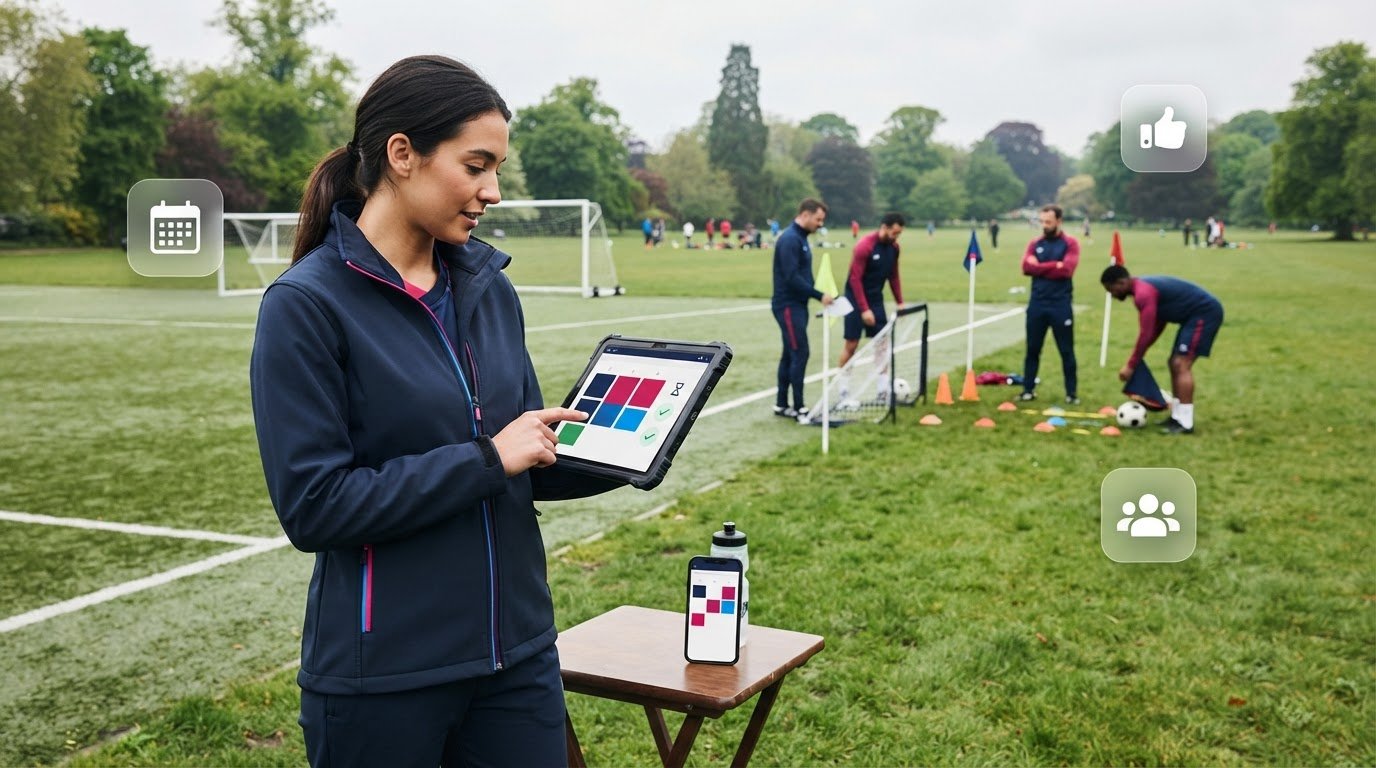

A full rota can still leave a sports session underprepared. If roles are vague, availability is out of date or qualifications sit in a separate record, assigning staff to sports sessions becomes a last-minute puzzle rather than a reliable process. Responsibilities can go uncovered, schedules may need avoidable changes and participants may have a less consistent experience.
The challenge is matching each session’s requirements with staff who are suitable and available, then making sure everyone understands their responsibilities before delivery.
This guide sets out a repeatable approach: define what each session needs, check staff skills and availability, confirm assignments clearly and prepare for changes. Before publishing the rota, check for conflicts, uncovered duties and unconfirmed assignments. You’ll also learn how centralised staffing coordination can help you oversee assignments across locations as your programme grows. Start with the session requirements, build the rota around clear criteria and give your team a plan they can follow.
Key Takeaways
- Define each session’s duties and requirements before choosing staff, so you know which roles need covering.
- Use a five-step process to assign staff to sports sessions, from defining needs to confirming the rota.
- Assess suitability, availability, workload and continuity separately to build balanced session coverage.
- Confirm each person’s role, time, location and responsibilities, then keep the schedule current when plans change.
- Centralised staffing coordination can help you oversee assignments and workforce deployment as programmes grow.
Why assigning staff to sports sessions needs a clear process
A rota can show that a session is covered without making clear who is doing what. To assign staff to sports sessions reliably, match each session’s duties with people who are suitable and available, then confirm the details with them. Plan beyond names in calendar slots: staff need to know where to be, when to arrive and which responsibilities they own.
This is practical Sport management: organising people and activities so delivery runs as planned. When ownership is unclear, preparation can be missed, attendance may not be checked and participants may be left waiting while staff work out who is responsible. A defined assignment process supports safe, consistent delivery and leaves room to respond when availability changes.
What does a complete session assignment include?
A complete assignment links one named person to a specific session, location, time and responsibility. It should distinguish who leads the coaching from who supports practical tasks, such as preparing equipment or checking that participants have arrived. These duties may belong to different people, so don’t rely on the team to infer who is responsible.
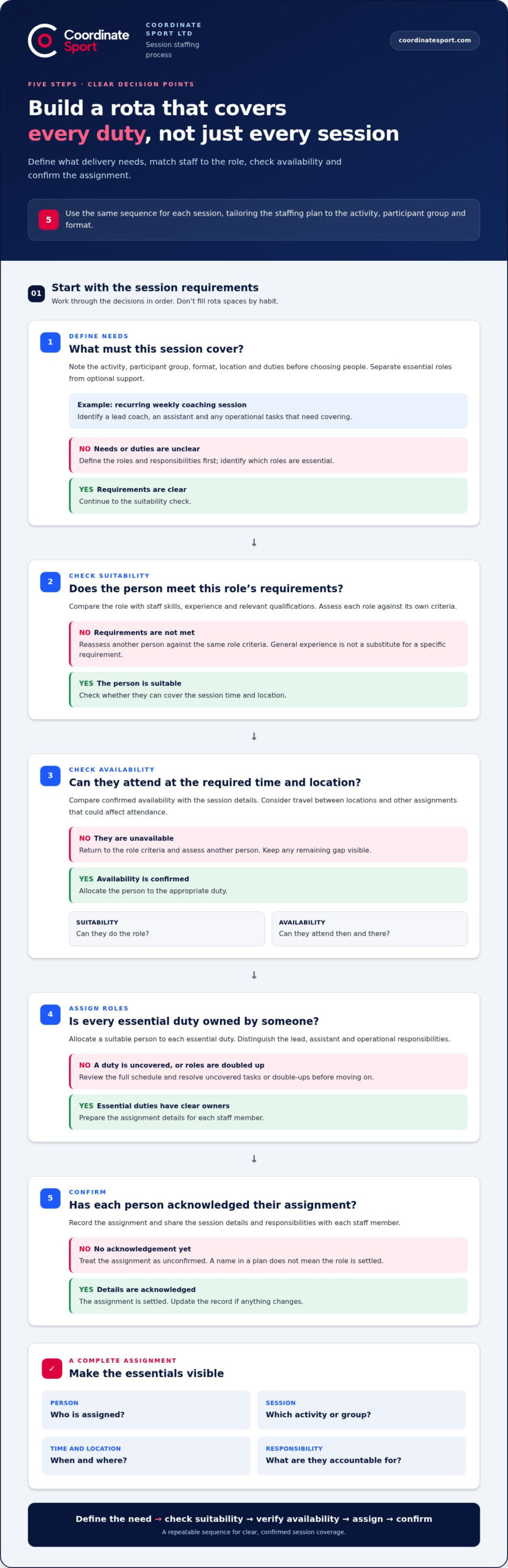
- Person: who is assigned.
- Session: which activity or group they’re covering.
- Time and location: when and where they’re expected.
- Responsibility: what they’re accountable for.
A rota entry isn’t the same as an agreed assignment. Ask staff to acknowledge the details and update the record if anything changes. This gives the organiser a clear view of confirmed coverage, rather than relying on an assumption that a message was seen or a calendar entry understood.
Where does session staffing commonly go wrong?
Problems often start when essential details are scattered across messages, calendars and spreadsheets. One record may show availability, another the session time and a message the latest change. Staff then have to piece together the plan, increasing the chance of missed updates or conflicting information.
Assumed responsibilities create another gap. If nobody is explicitly assigned to check attendance or prepare equipment, each person may expect someone else to do it. A session can look covered on paper while a practical duty remains unowned. Make responsibilities visible before delivery.
There’s also a capacity risk in repeatedly turning to the same dependable people. They may become the default because they respond quickly or know the programme well, but repeated assignments can leave them stretched and reduce flexibility when they’re unavailable. Review workload alongside suitability and availability, rather than treating familiarity as the only measure of fit.
A repeatable process helps you spot these issues early: define what the session needs, make ownership explicit and confirm the plan. Apply that sequence consistently so each assignment supports delivery without making the rota harder to adapt.
How to assign staff to sports sessions in five steps
Use the same decision sequence for each session, but tailor the staffing plan to the activity, participant group and format. A small indoor skills session may need different coverage from an outdoor activity with several stations. Define requirements first, then match people to them. This keeps the process focused on what delivery needs, rather than filling rota spaces by habit.
Define session roles before choosing people
List essential coverage first: who leads the session, who assists participants and which operational tasks need an owner. Set out each role’s responsibilities and the relevant experience or qualifications it requires. Separate essential roles from optional support, such as an extra helper for equipment. This makes it easier to see which gaps must be resolved before confirming the session.
Apply the sequence to a recurring weekly coaching session:
- Step 1: Define needs. Note the activity, participant group, format, location and duties. For the weekly session, identify a lead coach, an assistant and any operational tasks that need covering.
- Step 2: Check suitability. Compare each role’s requirements with staff skills, experience and relevant qualifications. Don’t treat general experience as a substitute for a specific role requirement.
- Step 3: Check availability. Compare confirmed availability with the session time and location. Consider travel between locations or another assignment that could affect someone’s ability to arrive and take part.
- Step 4: Assign roles. Allocate a suitable person to each essential duty. Distinguish the lead, assistant and operational responsibilities, then review the full schedule for double-ups or uncovered tasks.
- Step 5: Confirm. Record the assignment and send each staff member the session details and their responsibilities. Treat the role as settled once the person has acknowledged it, not simply because their name appears in a plan.
Match suitability with availability
Run these checks separately. A person may be capable of the role but unavailable at that time, or free but not suited to its requirements. If your first choice can’t cover the session, return to the role criteria and assess another person against the same requirements. Record the decision so the reasoning and any remaining gap are visible.
Define the need, check suitability, verify availability, assign clear roles and confirm the plan. This five-step process makes recurring staffing decisions repeatable while leaving room to adapt when the activity or delivery format changes. For programmes across locations, sports staffing coordination can help keep assignments and workforce deployment together as the schedule grows.
How to balance suitability, fairness and safe session coverage
A rota should do more than fill available spaces. Before confirming it, assess four separate factors: whether each person suits the role, whether they’re available at the right time and location, how the assignment affects their workload, and whether the plan maintains continuity for participants. Each check answers a different question, so don’t treat a free slot as proof that someone is the right choice.
A suitable assignment matches the person to the role, not just the person’s availability to an empty slot. Session demands vary by activity, participant group and format. Set coverage against the programme’s requirements and current risk assessment rather than relying on a universal staff-to-participant ratio.
How do you share workloads fairly?
Review the whole rota, not just the session in front of you. Repeatedly selecting the same available people can make a schedule seem dependable whilst placing too much pressure on a small part of the team. Review assignment frequency and role demands, then explain the principles you use, such as relevant experience, availability and balanced workload.
- Account for travel between locations and whether staff can reasonably arrive on time.
- Notice consecutive sessions and the preparation or transition time they require.
- Consider the demands of each role, not only the number of assignments.
- Preserve continuity where it benefits a group, while avoiding automatic repeat assignments.
Fairness doesn’t mean giving everyone identical assignments. It means applying clear, consistent criteria and being able to explain why a particular person was selected.
How should safety shape a staff assignment?
Check that each person meets the role-specific experience, qualification and organisational requirements that apply to your programme. Make supervision arrangements explicit: identify who leads, who supports and who is responsible for practical safety tasks. The right allocation depends on the activity and its assessed needs, so don’t use a generic ratio as a substitute for planning.
Clarify first-aid arrangements and who takes responsibility if an incident occurs. Apply your current safeguarding and risk-assessment procedures when deciding what coverage is needed. This makes safety considerations visible in assignment decisions, rather than leaving staff to work out responsibilities once the session is under way.
Before confirming the rota, check each session against its required roles. Mark a duty as uncovered if no suitable person has been assigned, or if availability, workload or required arrangements remain unresolved. Keep the gap visible while you review alternatives. An incomplete assignment is easier to address before the schedule is shared as final.
Then review the programme as a whole. Someone may be correctly assigned to one session but double-booked elsewhere, or a location may lack a clear lead. Rechecking the full schedule helps balance local coverage with overall capacity and continuity.
How to confirm assignments and prepare for staff changes
An assignment is dependable only when the right people have the same current information. Confirm the rota through a shared schedule, direct messages or another established channel. Consistency matters: staff should know where to find the latest plan, and colleagues coordinating delivery should be able to see which assignments are confirmed and which still need action.
What should staff receive when an assignment is confirmed?
Give each person the details they need to prepare, not just a session name. Ask them to acknowledge the assignment and flag any conflict promptly. Keep the latest confirmed schedule accessible to authorised colleagues, so coordinators aren’t relying on an old message or personal calendar to understand the plan.
- Session and time: identify the activity and start time, including relevant arrival or preparation expectations.
- Location: give the correct venue or meeting point, particularly if the programme uses multiple locations.
- Role and responsibilities: state what the person is leading or supporting and any duties they own.
- Preparation information: share relevant session notes, equipment details or operational instructions.
- Acknowledgement: record that the staff member has received and accepted the assignment, or flag it for follow-up.
Use a clear status such as proposed, confirmed or changed. This makes uncertainty visible and helps prevent an unacknowledged assignment from being mistaken for settled coverage.
How can you respond to cancellations without losing oversight?
Decide in advance who owns staffing changes and what they should do when someone cancels. That person can assess the affected session, find an available and suitable replacement, update the central schedule and notify relevant staff. Agree how urgent changes are communicated, but don’t assume one channel will work for every team or situation. Whatever the channel, keep the schedule as the definitive record.
For each change, work through this sequence:
- Record the cancellation against the specific session and identify which duty is now uncovered.
- Check possible replacements against the role requirements, availability, location and other assignments.
- Confirm the replacement’s responsibilities and update the schedule, including who has been notified.
- Tell affected colleagues about the change so they’re not working from an outdated version.
Keep the original gap visible until a suitable replacement has acknowledged the assignment. If no suitable person is available, escalate the issue to the named decision-maker to review the coverage plan rather than treating the session as staffed.
After delivery, note recurring cancellations or hard-to-fill assignments. A repeated gap at the same time or location may point to a scheduling or capacity pattern that needs attention. Reviewing these changes across the programme gives you a better basis for planning, instead of solving the same problem from scratch each week.
Coordinate Sport’s staffing application supports coordination of assignments and workforce deployment across multiple locations. Explore Coordinate Sport’s staffing application as part of your staffing process.
How a staffing application can simplify session assignments
Manual scheduling can work while a programme is small and changes are easy to track. As recurring sessions, staff and locations multiply, spreadsheets and message threads can drift apart. A change recorded in one place may not reach everyone using another version, and managers can spend more time checking records than reviewing coverage. The issue isn’t the spreadsheet itself; it’s losing a reliable, shared view of the staffing plan.
When is it time to move beyond manual staff scheduling?
Look for repeated schedule conflicts, duplicate staff records, missed updates or uncertainty about who is covering an activity. Ask whether managers can quickly see assignments across sessions and locations, including duties that still need coverage. If that overview requires repeated manual checks, a more central approach may help. Software should support a sound assignment process, not replace the judgement needed to assess suitability and coverage.
Before changing tools, identify where the current process breaks down. For example, if a staff member’s availability changes, can you identify the affected session, assignment and colleagues without searching several messages? If not, centralising schedule information can make changes easier to oversee. Keep role requirements and decision-making clear: a system can organise information, but people still need to make and confirm assignments.
How can Coordinate Sport support staff coordination?
Coordinate Sport’s specialist staffing application is designed for sports activity providers to coordinate and schedule coaching staff, track workforce deployment and manage assignments across multiple activity locations. A central view of staffing details can help managers review how people are deployed across a programme, rather than treating each session as an isolated rota entry.
This wider view is useful as programmes grow. Managers can see assignments across locations, identify where the staffing picture needs attention and maintain oversight of operational deployment. The application provides a structured place to manage scheduling information, while the established checks still guide who is suitable for each role and whether coverage meets the session’s needs.
Coordinate Sport’s activity management platform can bring staffing coordination and wider activity management into a more central process. Explore Coordinate Sport’s activity management platform. Whichever tools you use, keep the fundamentals in place: define roles, check suitability and availability, confirm assignments, then review the schedule for gaps and changes. This gives your programme a practical process to repeat and improve as delivery evolves.
Make your next rota easier to run
Put the process to work on your next scheduling cycle. Choose one programme, identify where assignments are most likely to change, then make it clear who owns each update. As you assign staff to sports sessions, use the rota review to spot recurring pressure points and improve how your team prepares for them. A consistent process gives you a stronger foundation as activities and locations expand.
As coordination grows more complex, a specialist staffing application can help keep scheduling, workforce tracking and deployment across multiple locations in view. Coordinate Sport supports sports activity providers with these staffing tasks, helping managers maintain operational oversight while making decisions around the needs of each session and team.
Explore how Coordinate Sport supports activity providers and consider how a central view could fit your programme. The aim isn’t simply to fill every slot. It’s to build an approach your team can understand, adapt and deliver with confidence. Take the next step and make your rota clearer.
Frequently Asked Questions
How do you assign staff to sports sessions?
To assign staff to sports sessions, begin with the duties the activity requires, then match each duty to someone suitable and available. For a session with several activity stations, identify who leads the group and who supports each station before allocating names. Record the person, session, time, location and responsibility together. Check the plan against your organisation’s requirements, then confirm any changes with staff before delivery.
What should you consider when assigning coaches to a session?
Consider the role’s requirements, each coach’s relevant qualifications and experience, availability, location, workload and the session’s supervision needs. Don’t let one factor decide the assignment in isolation: a free coach may not meet the role requirements, while a suitable person may already have another commitment. For example, check that someone can reach the venue in time after an earlier session. Make responsibilities clear and follow your organisation’s current safeguarding and safe-practice procedures.
How can sports organisations avoid last-minute staffing gaps?
Maintain a current schedule, ask staff to confirm their assignments and record changes as soon as they’re known. Name who coordinates replacements, so a cancellation doesn’t leave colleagues unsure who should act. If the same role is repeatedly uncovered, review the pattern: the session time, location or staffing plan may need attention. No process can prevent every absence, but visible changes and clear ownership make it easier to respond without relying on outdated messages.
How do you assign staff fairly across sports sessions?
Review assignment frequency and role demands across the programme, rather than judging fairness from one session alone. Avoid routinely relying on the same people just because they’re familiar with the activity or quick to respond. Fairness doesn’t require identical workloads: a person’s suitability, availability and the value of continuity may justify different allocations. Explain the principles you use, so staff understand how decisions are made and can raise workload concerns early.
Should every sports session have a designated first-aid contact?
Organisations should make first-aid arrangements and responsibilities clear in line with the activity, venue and their current procedures. The appropriate cover can vary, so don’t assume one staffing rule fits every session. Before participants arrive, identify who is responsible for the agreed arrangements and make relevant emergency information available to the staff who need it. Include this in session preparation, particularly when the activity, venue or delivery plan differs from the usual setup.
Can software help assign staff to sports sessions?
Yes. A staffing application can organise schedules, record assignments and give managers a clearer view of workforce deployment. This can be useful for recurring programmes, where changes to one session may affect other commitments, or for activities delivered across multiple locations. Software supports coordination; it doesn’t decide whether someone is suitable or whether a session’s requirements are met. Managers still need to apply their judgement and keep assignment information current.
What information should be included in a sports staff rota?
Include the session name, date, time, location, assigned staff, each person’s responsibilities and a clear status showing whether the assignment is confirmed or has changed. Add preparation or handover notes if staff need them to deliver their duties. Make the current rota accessible to colleagues responsible for coordinating the programme. Only include participant or sensitive staff information where it’s appropriate under your organisation’s data-handling procedures, and limit access to those who need it.