
What if taking a booking is only the starting line? Sports activity booking software should do more than collect names and payments. It should help your team turn registrations into well-coordinated sessions, courses, clubs, camps, holiday programmes and events.
When bookings and participant details sit in separate tools, staff may have to re-enter information or reconcile payment records by hand. As a programme grows, keeping each activity organised can become harder. A connected booking system brings customer accounts, payments, participant management, staff scheduling and reporting into a clearer workflow, from registration through to delivery.
This guide explains how to manage the booking journey, create a branded online experience for customers and organise operational details behind the scenes. It also covers how to assess a system against your actual programme formats, staffing needs and reporting responsibilities.
Key Takeaways
- Map the complete booking journey, from publishing activities to reviewing results, to find where information gets lost between tools.
- Use sports activity booking software to connect registrations with payments and participant records, helping reduce repeated data entry and hand-offs.
- Assess workflow coverage across customer bookings, payment handling, participant management, staff coordination and reporting.
- Match your requirements to the different demands of sessions, courses, clubs, camps, holiday programmes and events.
- Connect branded customer bookings with staff scheduling and reporting to strengthen oversight as your programme grows.
What is sports activity booking software, and who needs it?
Sports activity booking software is a system for publishing activities online, taking participant registrations and managing the booking records, payments and programme details that support delivery.
It is designed for sports clubs, activity providers and organisations that run structured programmes. Instead of treating every booking as a separate transaction, the system can connect a customer’s registration with their participant record and the activity they have booked. Staff then have a more consistent record to use for administration and delivery, while customers have a straightforward way to book.
Activity booking is different from booking a sports facility or venue. Facility-hire software focuses on reserving a space, such as a court for a particular time. Activity booking focuses on enrolling people in a programme, where the organiser needs to manage participants as well as the activity. Some organisations handle both workflows, but they serve different needs.
Which sports activities can an online booking system manage?
Each activity format creates different administrative requirements. A recurring session may involve a regular schedule and repeat attendance. A course can run across a set series of dates, while a camp or holiday programme may involve bookings for multiple days. Clubs often manage ongoing participation, whereas a one-off event has its own date and registration list.
When comparing systems, consider whether your team can keep each registration linked to the correct activity and relevant dates. For example, a provider running several holiday activities needs to distinguish the bookings for each programme, rather than having to piece together separate lists. The same principle applies when managing courses alongside regular sessions or events.
How does activity booking software differ from general booking tools?
General appointment tools are often built around selecting an available time, making them a natural fit for one-to-one appointments or bookable slots. Appointment scheduling software describes this broader category. Sports activity booking software applies the booking process to programmes with participants, schedules and ongoing delivery requirements.
The distinction is useful, but not absolute. A general tool may handle a straightforward booking effectively. Activity providers, however, can benefit from keeping registrations, payments, participant accounts and programme records connected. This avoids entering the same details in several places and gives staff a consistent record to refer to as bookings move into delivery.
How sports activity booking software connects the customer journey
A booking is more than a name on a list. It creates information your team needs to carry forward, from a customer’s first view of an activity to the records managers use to oversee delivery. When each step uses connected records, staff have fewer details to re-enter and fewer updates to pass between separate tools.
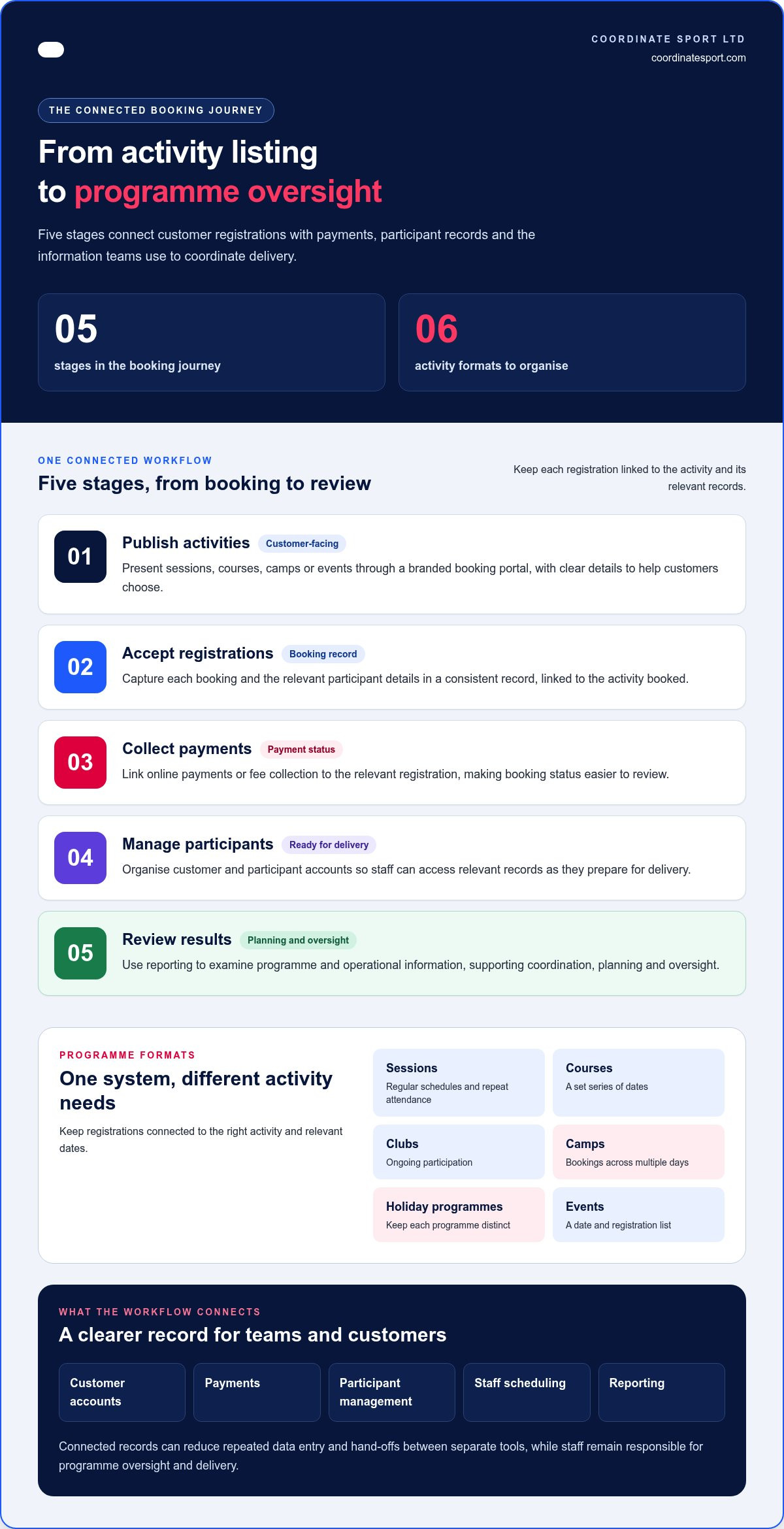
The journey typically follows five stages:
- Publish activities: Present sessions, courses, camps or events through a branded booking portal, with clear details to help customers choose.
- Accept registrations: Capture each booking and the relevant participant details in a consistent record.
- Collect payments: Link online payments or fee collection to the relevant registration, making booking status easier to review.
- Manage participants: Keep customer and participant accounts organised so staff can access relevant records as they prepare for delivery.
- Review results: Use reporting to examine programme and operational information, then inform planning and oversight.
Some routine steps can be automated, such as recording an online registration or updating a booking record after payment. This can reduce manual handling while leaving staff responsible for programme oversight and delivery.
From activity listing to confirmed registration
A branded portal gives customers a clear place to browse activities and register. Each listing should give them the information they need to choose, whether they are booking a weekly session, a multi-date course, a camp or a one-off event. Online registration captures booking details directly, avoiding a separate form that staff then have to re-enter.
Customer accounts give people a way to manage relevant booking information, while the organisation has a consistent record to work from. Staff can see which activity a registration relates to and keep the details connected as it moves towards delivery.
From payment and participant records to programme oversight
Online payments and fee collection are part of the same journey as registration. When payment information is associated with a booking, staff can review it alongside the participant’s details and the activity they have joined. Customer and participant accounts also bring relevant records together, instead of splitting information across inboxes, spreadsheets and payment tools.
Reporting provides a management view of programme activity and operational information. Teams can review records across their activities to support coordination and planning. Managers, funders and commissioners can also draw on relevant reporting for oversight.
Connected booking records turn individual registrations into a clearer view of programme activity, payments and delivery. Explore how sports booking and activity management can connect these steps through Coordinate Sport’s platform.
What should sports activity booking software manage?
A calendar can show what is scheduled, but it will not necessarily manage who has registered, whether fees have been collected or which staff are involved in delivery. Assess sports activity booking software by how well it supports the whole operation, not simply how activities appear in a diary.
The right mix depends on your programme’s complexity, delivery model and reporting needs. A small club with a straightforward weekly schedule may prioritise bookings and participant records. An organisation coordinating courses, holiday programmes and events may also need connected staff scheduling and management reporting.
| Workflow area | What it should support | Why it matters |
|---|---|---|
| Customer booking | A branded portal where customers can view activities and register online. | Creates a clear route from discovering a programme to making a booking. |
| Payments | Online payments and fee collection associated with bookings. | Helps staff review payment information alongside registration details. |
| Participant records | Customer and participant accounts linked to relevant activities. | Gives staff organised records to support administration and delivery. |
| Staff coordination | Scheduling that connects staff assignments with activity delivery. | Supports coordination when programmes involve multiple sessions or locations. |
| Reporting | Programme and operational information for managers, funders and commissioners. | Provides a basis for oversight and review. |
Which booking features matter for activity providers?
Start with the everyday customer and administration journey. Can people find activities through a branded portal, register online and use customer accounts? Can staff link each booking to the right participant and programme, whether it is a recurring session, course, camp or event? These are core workflow questions. Then distinguish essential requirements from preferences, such as the layout of an internal calendar. A feature is most useful when it addresses a real operational need.
When do staff scheduling and reporting become important?
Staff coordination becomes more important when delivery involves several sessions, teams or locations. A staffing application can connect assignments with the activities they support, rather than leaving schedules apart from booking records. Reporting adds another layer: managers can review programme and operational information, while relevant reports can support updates for funders and commissioners.
Assess each capability against the work it needs to support. The aim is not to collect the longest feature list. It is to bring the right customer, payment, participant, staffing and reporting workflows into view, so your team can coordinate delivery with stronger oversight.
How to assess sports booking software against your real workflow
Start with the way your organisation currently takes bookings and prepares activities for delivery. Mapping each step makes it easier to identify where sports activity booking software needs to connect customer registrations with payment handling, participant records, staff coordination and reporting. It also gives you practical criteria for comparing platforms, based on operational needs rather than a long list of features.
Map the booking process your organisation needs
Trace the journey from publishing an activity to preparing the team and reviewing the programme afterwards. Include the different formats you run, such as recurring sessions, courses, clubs, camps, holiday programmes and events. Note what changes between them: a course may have several dates, while an event may have a single registration period and a defined participant list.
Use this checklist to capture the work involved:
- Customer journey: How do people find activities, register and access their booking details?
- Programme types: Which formats, schedules and capacities does the organisation need to manage?
- Payment handling: How are fees collected, recorded and matched to registrations?
- Participant records: What information do staff need to prepare for activity delivery?
- Staff coordination: Do coaches or activity teams need to be assigned to sessions or locations?
- Reporting: Which programme and operational details do managers need to review?
Mark every point where staff copy details between tools, track payments manually or pass information to another team member. These are useful places to focus when assessing whether a connected workflow could simplify administration. Then consider how the process might change as you add activities, dates, delivery teams or participants. Choose a system that supports the work you do now and keeps the moving parts visible as the programme grows.
Check whether the system supports managers as well as customers
A smooth customer-facing booking journey matters, but it is only one part of the assessment. Consider whether staff can use the resulting records to manage participants and prepare for delivery. If several teams or locations are involved, look at how staff scheduling fits alongside activity and participant information.
Finally, define who needs reporting and what they need to understand. Managers may want an overview of programme activity, while funders or commissioners may need relevant information about delivery. Clear requirements help you judge whether reporting supports real oversight, rather than simply presenting data without answering an operational question.
Explore how Coordinate Sport’s activity management and booking platform brings customer bookings, staff coordination and reporting together.
Coordinate Sport brings bookings and activity operations together
Coordinate Sport connects online bookings with the operational records teams need to organise activity delivery. Its sports activity booking software supports branded customer booking portals, online registration and payments, participant accounts, staff scheduling and reporting. This makes booking part of a wider workflow, rather than a process that ends when a customer secures a place.
One platform for sports sessions, courses, camps and events
Organisations can use Coordinate Sport for online booking and registration for sessions, courses, clubs, camps, holiday activity programmes and events. A branded customer portal gives people a consistent place to view activities and register, while online payments and fee collection connect payment to the booking process.
Customer and participant accounts help keep relevant details organised around the people taking part. Staff can manage records in relation to the activities customers have booked, supporting administration across different programme formats. Whether a schedule recurs or a programme runs on set dates, connected booking and participant information gives the organisation a consistent foundation for coordination.
Move from booking records to delivery oversight
Registration is the start of the operational journey. Coordinate Sport’s specialised staffing application supports scheduling and coordinating sports activity staff, helping teams connect staff assignments with programme delivery. Activity management brings these operational needs into the wider picture alongside the customer and participant records created through booking.
Reporting provides information for management teams, funders and commissioners. Teams can use relevant programme and operational data to review activity and support oversight. The questions will vary by organisation, but connecting reporting with programme records makes that information part of the management workflow.
For sports organisations looking to bring customer bookings, payments, participant administration and staff coordination together, Coordinate Sport offers a connected platform for activity management. Explore Coordinate Sport’s booking platform to see how its capabilities can support your organisation’s programme workflow.
Connect every booking to better programme delivery
Choose sports activity booking software that supports the full journey, not just the moment a customer reserves a place. Branded booking portals, online registration and payment collection give customers a clear route to enrol, while connected participant records help teams organise programme administration.
Look beyond the customer journey, too. Staff scheduling can support coordination across activity delivery, and reporting can give management teams, funders and commissioners relevant information for oversight. The right setup should fit your programme formats and the way your organisation works today, while helping you manage changing operational needs.
Coordinate Sport brings these capabilities together, connecting branded bookings and participant accounts with a specialised staffing application and reporting. Explore Coordinate Sport’s booking platform to see how it can support your organisation’s workflow. With a connected operational foundation, your team can spend less effort joining up separate records and focus more confidently on delivering the programme.
Frequently Asked Questions
What is sports activity booking software?
Sports activity booking software lets organisations publish activities online, take registrations and manage related booking records. It can connect a customer’s booking with payment collection and participant information, helping staff organise the work behind delivery. For example, a provider can manage registration records for a course or holiday programme in one system, rather than re-entering booking details across separate tools.
Can sports activity booking software manage camps, courses and regular sessions?
Yes. It can support online booking and registration for camps, courses, recurring sessions, clubs, holiday activity programmes and events. Each format has different administrative needs: a course may run across set dates, while a recurring session follows a regular schedule and a camp may involve several days. Keeping bookings linked to the relevant activity helps staff organise registrations and participant records across programme types.
How does sports booking software differ from facility booking software?
Sports booking software for activities focuses on registering participants for a programme. Facility booking software focuses on reserving a venue or space for a time slot, such as a court or sports hall. The distinction matters because activity providers need to manage participant and programme records, while venue operators may prioritise availability and facility reservations. Some organisations run both workflows, but each addresses a different part of operations.
Can customers pay online when booking a sports activity?
Yes. A booking platform can let customers pay online as part of registration, with fee collection connected to the booking record. This gives staff a more organised way to review payment information alongside activity and participant details, rather than tracking transactions separately. Coordinate Sport provides online payments and fee collection through its booking platform for organisations managing sports activities.
Does booking software manage participant details and staff schedules?
It can bring customer and participant account management together with activity bookings, helping staff access relevant records for programme administration. Staff scheduling is a separate but connected operational need. Coordinate Sport’s specialised staffing application supports sports activity providers with scheduling and coordinating staff. Connecting these capabilities helps teams consider participant registrations and staff assignments as part of preparing for delivery.
How can a sports booking platform support reporting?
A sports booking platform can organise programme and operational information for review. Reporting can help management teams understand activity records and support oversight, while relevant data can also be used for funder and commissioner reporting. The useful information depends on the questions each organisation needs to answer, such as what programme activity has been recorded and which details teams need to review delivery.
Is sports activity booking software suitable for a growing organisation?
It can be a good fit when an organisation needs to coordinate more activities, registrations or delivery tasks. Assess whether the system can support your programme formats and bring bookings, payments, participant accounts, staff scheduling and reporting into a workflow that suits your team. Mapping how your needs may change as programmes expand helps you focus on the capabilities that will support ongoing administration and oversight.