
A full report can still leave commissioners unsure whether a sports programme is making progress. The value of sports commissioner reporting tools is not the amount of data they collect, but how clearly they show delivery against agreed outcomes.
Commissioners need to compare provision, participation and progress without spending hours combining provider reports in different formats. When attendance, delivery and participant records are incomplete or disconnected, it becomes harder to build a consistent picture and make informed management or funding decisions.
This guide explains which reporting capabilities support commissioning workflows and how to assess whether a tool makes programme activity and agreed outcomes easier to understand. It also shows how connected booking, registration and activity records can provide a clearer evidence trail. Coordinate Sport brings together operational information with reporting and data for commissioners, funders and management teams.
Key Takeaways
- Start with agreed outcomes and reporting requirements so providers know what evidence to capture and when to submit it.
- Assess sports commissioner reporting tools by how consistently they present data, preserve programme context and support practical oversight.
- Separate delivery outputs, participation measures and outcome evidence to make reports clearer and more proportionate.
- Use consistent definitions and reporting periods to make provider submissions easier to compare and review.
- Connect booking, registration and participant records with activity management to build a more useful evidence trail.
What sports commissioner reporting tools need to show
Commissioner reporting is the process of collecting, reviewing and communicating evidence about a funded sports programme. It connects what a provider agreed to deliver with records of what took place, who took part and how delivery relates to intended outcomes.
Definition: Sports commissioner reporting tools help commissioners and providers collect, review and communicate consistent evidence of programme delivery, participation and progress against agreed outcomes.
This evidence supports oversight and decision-making, but it needs careful interpretation. A report can show that activities ran and participants attended. It cannot, by itself, prove that a programme caused a particular change. Outcomes may be influenced by other factors, so reports should distinguish recorded activity from evidence of progress and explain any limitations.
What does a commissioner need to monitor?
Start with each programme’s commitments. Reports should show planned and delivered sessions, dates, locations and changes to the agreed provision. Clear records help commissioners see where delivery matches the plan and identify exceptions that need explanation.
Next, show participant reach using relevant registration and attendance records. These measure different things: registration indicates who signed up, while attendance records who took part. Report both against the programme’s requirements and intended outcomes, rather than treating one count as a complete picture.
How is commissioner reporting different from general sports reporting?
Internal operational reporting helps a provider manage day-to-day work, such as bookings, staffing and session attendance. Commissioner reporting uses relevant operational information to support oversight of agreed delivery and inform management or funding decisions. The difference is the purpose: commissioners need evidence they can assess against the programme’s commitments.
Comparable information matters across providers, but figures need context to be useful. A participant total is difficult to interpret without the reporting period, a definition of participation and a description of which activities are included. Agreed definitions make comparisons more meaningful without overlooking differences between programmes.
The wider field of sports analytics includes on-field performance information and off-field business data. Commissioner reports should focus on information relevant to funded activity and its intended outcomes. A dashboard can bring measures together, but no single metric establishes impact. Pair figures with clear definitions, delivery context and an honest account of what the evidence can and cannot show.
Build a commissioner reporting workflow from requirements to evidence
A reliable reporting process starts before delivery, not when a report is due. Agree what evidence is needed, capture it consistently, then use it to guide oversight and decisions. This gives commissioners and providers a shared standard instead of a last-minute exercise in reconciling spreadsheets.
Agree outcomes, measures and reporting expectations first
For each intended outcome, define the measure, reporting frequency, responsible owner and evidence source. For example, session records can report delivery, while attendance records show participation. Keep required measures distinct from useful context, such as changes to planned locations, to keep reporting proportionate and focused.
Set these definitions in the programme agreement before activity begins. Specify the reporting period and what terms such as “session delivered” or “participant reached” mean. Shared definitions make provider submissions easier to compare and reduce avoidable follow-up.
Collect and review evidence throughout delivery
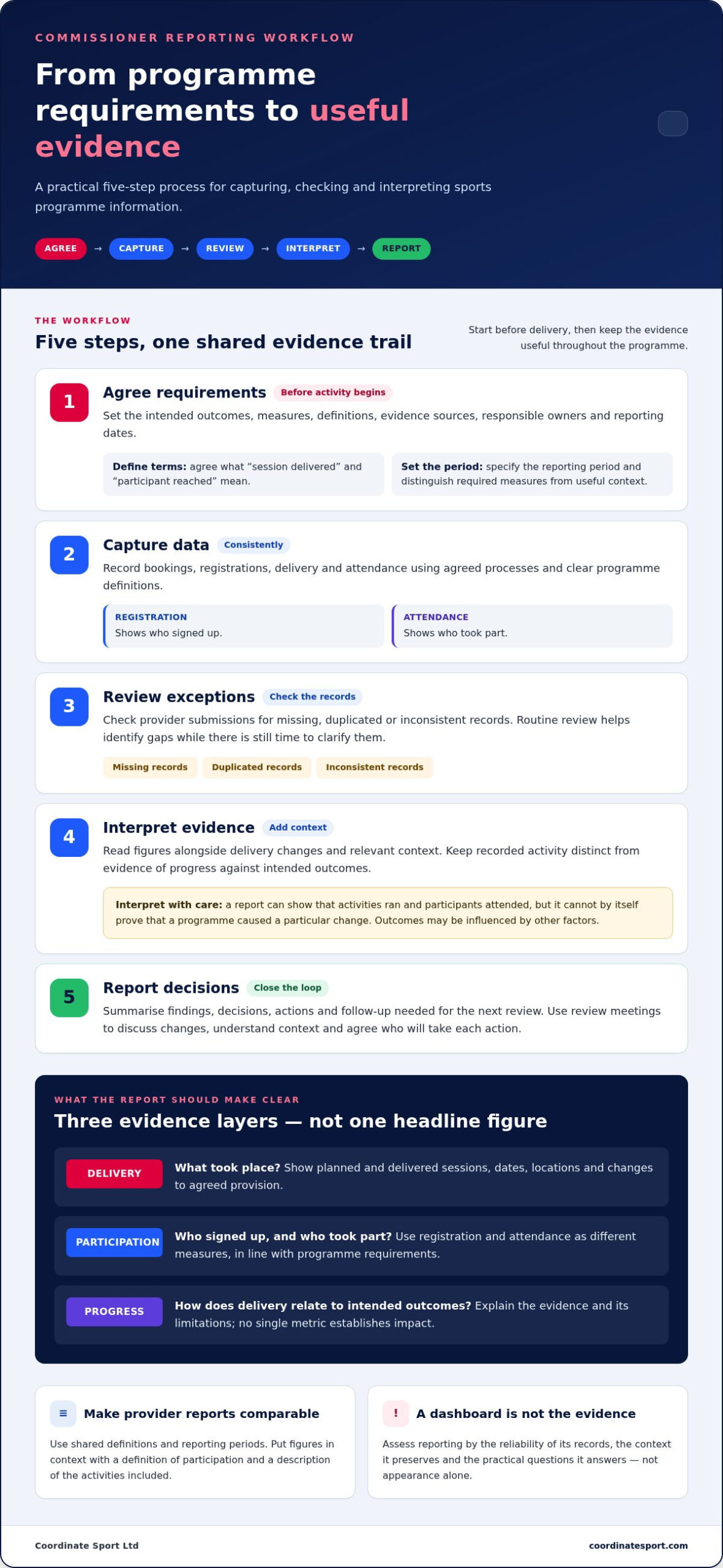
Use a practical five-step workflow:
- Agree requirements: Confirm outcomes, measures, definitions, owners and reporting dates.
- Capture data: Record bookings, registrations, delivery and attendance using consistent processes.
- Review exceptions: Check submissions for missing, duplicated or inconsistent records.
- Interpret evidence: Consider what the figures show alongside delivery changes and relevant context.
- Report decisions: Summarise findings, actions and follow-up needed for the next review.
Booking and participant records can support operational reporting when they use clear programme and reporting-period definitions. A scheduled review helps identify gaps while there is still time to clarify them. Use review meetings to discuss changes, understand context and agree who will take each follow-up action.
Consistent requirements, routine checks and clear interpretation turn programme records into useful evidence. Software can support the process, but it cannot guarantee data quality on its own.
Connected booking, registration and activity records can make operational information easier to bring together. Sports activity management software can help providers organise these records alongside reporting for commissioners, funders and management teams.
Compare sports commissioner reporting tools by evidence quality
A clear dashboard can look impressive and still leave a commissioner without the evidence needed to oversee a programme. Compare sports commissioner reporting tools by how well they organise reliable records, preserve context and answer practical questions, not by appearance alone.
| Evidence area | Spreadsheet-led process | Connected software |
|---|---|---|
| Data consistency | Templates can standardise submissions, but different versions and manual entry may introduce variation. | Shared records may reduce repeated entry, provided teams use consistent definitions and processes. |
| Programme context | Context can be added in notes, but may be separated from the figures or applied inconsistently. | Programme and activity records can sit alongside participation information, depending on the system. |
| Reporting access | Files can be shared with relevant users, though access and version control may need manual oversight. | Role-based access may be available, but the actual permissions should be demonstrated. |
| Actionable oversight | Teams can review data and identify issues, though consolidation often requires manual work. | Connected reporting may bring delivery and participation information together for review. |
Neither approach suits every organisation. A small programme with few providers may be well served by a carefully maintained spreadsheet. Where activity and participant records are spread across separate processes, connected software may help bring information together. Either way, reports should state what each measure means, the period covered and the source of the data.
Which reporting capabilities matter to commissioners?
Check whether evidence can be organised by programme, activity, reporting period and relevant participant group. Commissioners should be able to review delivery, registrations and attendance together, while retaining enough detail to understand each figure. Access matters too: providers and commissioners need information appropriate to their respective roles.
How can commissioners judge data quality and usefulness?
Look beyond charts. Assess whether records are complete, consistent and timely, and whether figures can be traced back to their source. Summaries should retain enough programme context to explain differences rather than encourage misleading comparisons.
Use real reporting questions in a product demonstration. For example: “Which planned activities were delivered during this period?” or “How do registrations compare with recorded attendance?” Ask to see how the report defines its measures, handles missing information and presents relevant context. Check that the demonstrated capabilities match the programme’s reporting requirements. The test is simple: can the evidence support a clear, proportionate decision?
Turn sports programme data into proportionate, useful reports
A useful report makes evidence easier to act on, not simply longer. Separate what the programme delivered from who took part and what the evidence suggests about progress towards intended outcomes. These categories answer different questions and should not be presented as interchangeable measures of success.
- Outputs: Activities delivered against the agreed plan, such as sessions held or locations covered.
- Participation: Registrations and recorded attendance, using clearly stated definitions.
- Outcome evidence: Information relevant to the programme’s intended changes, with its source and limitations explained.
Attendance can show participation, but it does not, on its own, prove broader social or behavioural change. Match each measure to an agreed delivery commitment, a participation question or an intended outcome. Use Sport England or Active Lives Survey terminology only when it fits the programme and aligns with the current relevant framework.
Choose measures that answer a commissioning question
Before adding a figure, ask what decision or learning need it serves. Does it show whether delivery took place, who participated, or whether there is evidence relevant to an intended outcome? If a measure does not answer an agreed question, leave it out or label it as optional context. This keeps reports focused and reduces the risk of overstating what the data can show.
Make reports clear, comparable and responsible
Set consistent definitions and reporting periods before comparing providers or programme cycles. A short summary should state the period covered, explain key measures, identify data sources and include delivery context that could affect interpretation. If records are incomplete, a figure is estimated or programmes differ in a relevant way, say so plainly. Transparency makes evidence more useful, not less.
Exception reporting can focus review where it is most needed. Flag missed delivery, unexpected changes or gaps in records, then explain what follow-up is required. This helps commissioners distinguish a genuine concern from a change with a clear operational explanation.
For participant information, apply appropriate data handling and access controls in line with the organisation’s current UK GDPR responsibilities. Share only the information needed for the reporting purpose, and make sure access suits each user’s role.
Report only measures that serve an agreed oversight or learning purpose. A concise report built on that principle is easier to review and more likely to support a clear next step. Explore commissioner reporting and data to see how activity information can support evidence-led oversight.
Connect reporting with sports activity delivery and management
Commissioner reports are only as useful as the operational records behind them. If bookings, registrations, attendance and delivery notes sit in separate places, providers may need to piece together the story at reporting time. Connecting activity management with participant records gives teams a clearer route from planned provision to evidence they can explain.
Link bookings and participant records to programme oversight
Follow the journey from a participant registering for an activity to their attendance being recorded and included in programme reporting. Each stage answers a different question: who signed up, what activity was scheduled, what was delivered and who took part. Consistent records help providers present these details coherently, while agreed definitions keep the figures meaningful for commissioners.
Delivery context matters too. If a session changes location or a staffing adjustment affects how an activity runs, relevant operational information can help explain the record. It does not replace the agreed measures; it helps commissioners understand exceptions and decide whether follow-up is needed. Strong sports commissioner reporting tools should sit within a clear reporting process, supported by accurate records and practical review.
Choose a platform that supports delivery as well as reporting
Reporting should not be treated as a separate task from running the programme. Assess booking, participant management, activity oversight and reporting as connected operational needs. Providers organising sessions, courses, clubs, camps, holiday programmes or events benefit from records tied to the activity being delivered, rather than disconnected information assembled at the end of a reporting period.
Coordinate Sport brings sports CRM, online booking and registration, participant management, activity management and staffing tools together. Its reporting and analytics support management teams, funders and commissioners. This gives providers a practical foundation for organising delivery records and communicating relevant evidence, without suggesting that software alone determines data quality or proves programme impact.
When reviewing your process, consider where booking, participation and delivery information currently sits, and how clearly it supports agreed reporting requirements. A connected operational approach can help reduce manual collation while keeping programme context in view.
Explore how the platform can support your activity management and commissioner reporting workflow: Explore Coordinate Sport.
Make your reporting evidence count
Strong sports commissioner reporting tools start with agreed outcomes, consistent records and reports that explain what the evidence can and cannot tell you. Separate delivery, participation and outcome measures, then add the definitions and context needed to make findings useful for oversight and decisions.
Connected booking, registration, participant management and activity management can help providers build a clearer evidence trail from programme delivery. Coordinate Sport’s reporting and analytics support management teams, funders and commissioners, bringing reporting into the wider workflow of running sports activity.
Ready to connect delivery records with clearer reporting? Explore Coordinate Sport’s sports management platform and see how it can support your organisation’s activity management and reporting workflow.
With clear requirements and the right operational foundations, programme data can become evidence that supports confident decisions and continued improvement.
Frequently Asked Questions
What are sports commissioner reporting tools?
Sports commissioner reporting tools are systems and processes for collecting, reviewing and communicating evidence about commissioned sports activity. They help commissioners and providers assess delivery against agreed commitments, understand participation records and consider progress towards intended outcomes. Tools may include reporting software, booking and participant records, and standardised templates. Their value depends on clear definitions and consistent use: a dashboard can organise information, but it cannot establish programme impact by itself.
What should a sports commissioner report include?
A commissioner report should include information relevant to the programme agreement, such as planned and delivered activity, the reporting period, registrations and recorded attendance. It should define each measure, identify its data source and provide enough delivery context to interpret changes or exceptions. Include outcome evidence only where it relates to agreed intentions, and explain gaps or limitations. A focused report supports oversight better than a long list of measures without a clear purpose.
How can commissioners measure the impact of sports programmes?
Commissioners can assess impact by linking evidence to agreed outcomes and reviewing relevant measures over time alongside delivery and participation information. First separate outputs, such as sessions delivered, from reach, such as attendance, and from evidence of intended change. Attendance alone does not prove that a programme caused wider social or behavioural outcomes. Consider context, data limitations and other possible influences before drawing conclusions or using findings to guide decisions.
Can booking software help with sports programme reporting?
Yes. Booking software can help organise registration and activity records that providers may use when reporting participation and delivery. For example, registration information can show who signed up, while attendance records indicate who took part. These are different measures, so define and interpret them separately. Sports commissioner reporting tools are most useful when operational records are consistently maintained and reporting requirements are agreed, rather than relying on software to resolve gaps automatically.
How often should sports activity providers report to commissioners?
Providers should report at the frequency agreed for the programme, rather than follow a universal timetable. Set reporting dates and periods before delivery begins, taking account of the oversight and learning needs the report must support. Regular operational checks can help identify missing or inconsistent records between formal submissions. A clear schedule gives providers time to prepare evidence and commissioners a consistent basis for reviewing delivery and agreeing follow-up.
How can commissioners compare reports from different sports providers?
Commissioners can make reports more comparable by setting shared definitions, required measures and reporting periods before providers submit evidence. Clarify what counts as a delivered activity, a participant or an attendance record, and ask providers to identify data sources and relevant context. Compare like with like, and flag differences in programme scope or recording methods rather than treating figures as directly equivalent. Consistency supports fairer review without removing important programme detail.
How should sports programme reports handle participant data?
Reports should use only participant information needed for the agreed reporting purpose, with access limited to people who need it for their role. Where summary or grouped figures can answer the commissioner’s question, avoid including identifying details. Set clear processes for handling, storing and sharing records, and follow your organisation’s current data protection responsibilities. Make sure reports explain what information is included without exposing personal details unnecessarily.